
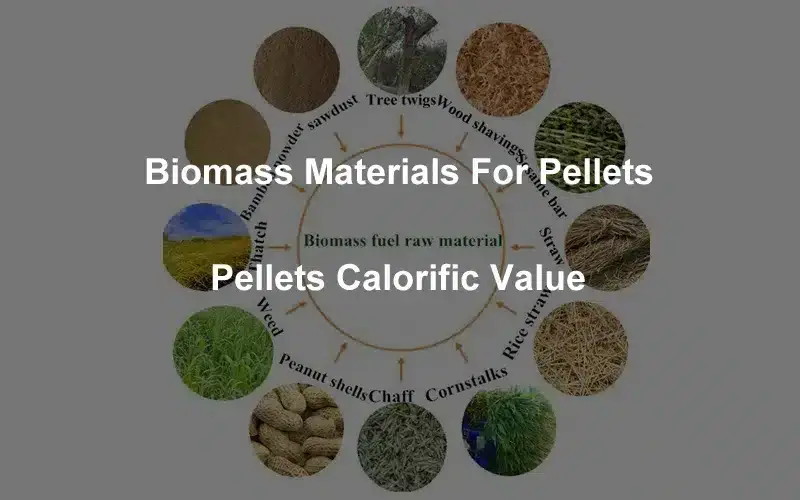
Biomass Materials for Pellets and Calorific Value
Biomass materials for pellets include clean wood residues, sawdust, bamboo waste, straw, stalks, husks, shells and some agricultural residues. For pellet production, the best raw material is not only the one with a high calorific value. Moisture, ash content, particle size, fiber structure, feeding stability and pellet mill die selection also affect final pellet quality.
For a commercial biomass pellet project, TCPEL usually checks raw material photos, moisture, planned capacity, target pellet diameter, voltage and final use before recommending a biomass pellet machine or complete line.
Common Biomass Materials for Pellets
- Wood residues: sawdust, wood chips, shavings, logging residues, furniture factory waste and clean pallet waste.
- Bamboo residues: bamboo processing waste, chopstick waste and toothpick factory waste.
- Agricultural residues: corn stalk, wheat straw, rice straw, cotton stalk, soybean stalk, rapeseed stalk and sorghum stalk.
- Husks and shells: rice husk, peanut shell, coconut shell, palm fiber, tea seed husk and similar residues.
- Special materials: bagasse, furfural residue, leaves and other local biomass materials that need pre-testing.
Biomass Pellet Calorific Value Reference
| Biomass material | Typical calorific value | Pellet production notes |
|---|---|---|
| Wood chips | around 4,401 kcal/kg | Good pelletizing behavior when clean and properly dried |
| Pine wood | around 4,552 kcal/kg | Higher resin content can help bonding, but moisture still matters |
| Chinese fir | around 4,587 kcal/kg | Typical forestry raw material for wood pellets |
| Poplar | around 4,286 kcal/kg | Common wood raw material with moderate pelletizing difficulty |
| Firewood residues | around 4,003 kcal/kg | Sort and crush before drying and pelletizing |
| Peanut shells | around 4,100 kcal/kg | Check ash and dust before pelletizing |
| Rice husk | around 3,300-3,500 kcal/kg | Higher ash and silica can increase wear |
| Rice straw | around 3,400-3,600 kcal/kg | Needs crushing and moisture control |
| Wheat straw | around 3,400-3,600 kcal/kg | Light material; feeding stability is important |
| Corn stalk | around 3,500-3,700 kcal/kg | Particle size and die compression ratio affect output |
| Corn cob | around 3,500-3,800 kcal/kg | Usually needs crushing before pelletizing |
| Sorghum stalk | around 3,350 kcal/kg | Typical agricultural residue; pre-test recommended |
| Bean pole | around 3,862 kcal/kg | Clean and dry before hammer milling |
| Tree leaves | around 3,300 kcal/kg | Ash and moisture can vary widely |
| Weed or grass pellets | around 3,800 kcal/kg | Bulk density and feeding can be challenging |
| Sophora stick | around 4,323 kcal/kg | Woody material; confirm hardness and moisture |
| Furfural residue | around 3,145 kcal/kg | Check moisture, ash and binder behavior |
| Cow dung | around 2,779 kcal/kg | Usually lower calorific value and higher handling risk |
What Affects Pellet Quality?
Raw Material Type
Wood materials are often easier to pelletize than many agricultural residues because of fiber structure and natural lignin. Straw, husk and stalk materials may need more careful crushing, drying and die selection.
Particle Size
Most biomass materials should be crushed before pelletizing. Oversized particles can reduce forming quality and increase die and roller wear. Very fine powder may improve bonding but can also increase crushing energy and feeding difficulty.
Moisture Content
Many biomass pellet projects target about 10-15% moisture before pelletizing. Wet materials normally need a rotary dryer. Very dry materials may be difficult to press and can produce loose pellets.
Pellet Mill Die and Compression Ratio
The suitable die compression ratio depends on the raw material. Agricultural residues, softwood, hardwood and mixed biomass can require different die settings. A test run is useful before confirming a large project.
Typical Biomass Pellet Production Process
| Process step | Purpose | Related equipment |
|---|---|---|
| Crushing | Reduce material size for stable pelletizing | Hammer mill |
| Drying | Bring moisture into a suitable pelletizing range | Rotary dryer |
| Pelletizing | Press prepared biomass through the die | Pellet mill |
| Cooling and screening | Stabilize pellets and remove fines | Pellet cooler and screener |
| Packing | Pack finished pellets for storage or delivery | Pellet packing machine |
FAQ
Which biomass materials are commonly used for pellets?
Wood chips, sawdust, bamboo waste, straw, corn stalk, rice husk, peanut shell, palm residue and similar clean biomass residues can be used after proper preparation.
Do higher calorific values always mean better pellets?
Not always. Moisture, ash, raw material stability, pellet strength and equipment wear also matter in commercial pellet production.
What moisture is usually needed before pelletizing?
Many biomass pellet projects target about 10-15% moisture before pelletizing, but the suitable range depends on the material and pellet mill setup.
Do agricultural residues need a hammer mill?
Usually yes. Straw, stalks and husks should be crushed to a suitable particle size before stable feeding into the pellet mill.
When is a dryer needed in a biomass pellet line?
A dryer is needed when incoming biomass moisture is too high for stable pelletizing or storage.
Send your biomass raw material, moisture and target capacity to TCPEL on WhatsApp.
Talk to a Biomass Pellet Line Expert
Talk to An Expert
 English
  Español de México
  Bahasa Indonesia
  العربية
  Français
  Русский
  Português do Brasil
  Italiano